Legend of the Primordial Lotus
According to the Swayambhu Purana, the entire Kathmandu valley was once a vast lake. A radiant lotus sprouted in the center, which transformed into the hilltop stupa when Manjushri drained the lake with his sword.
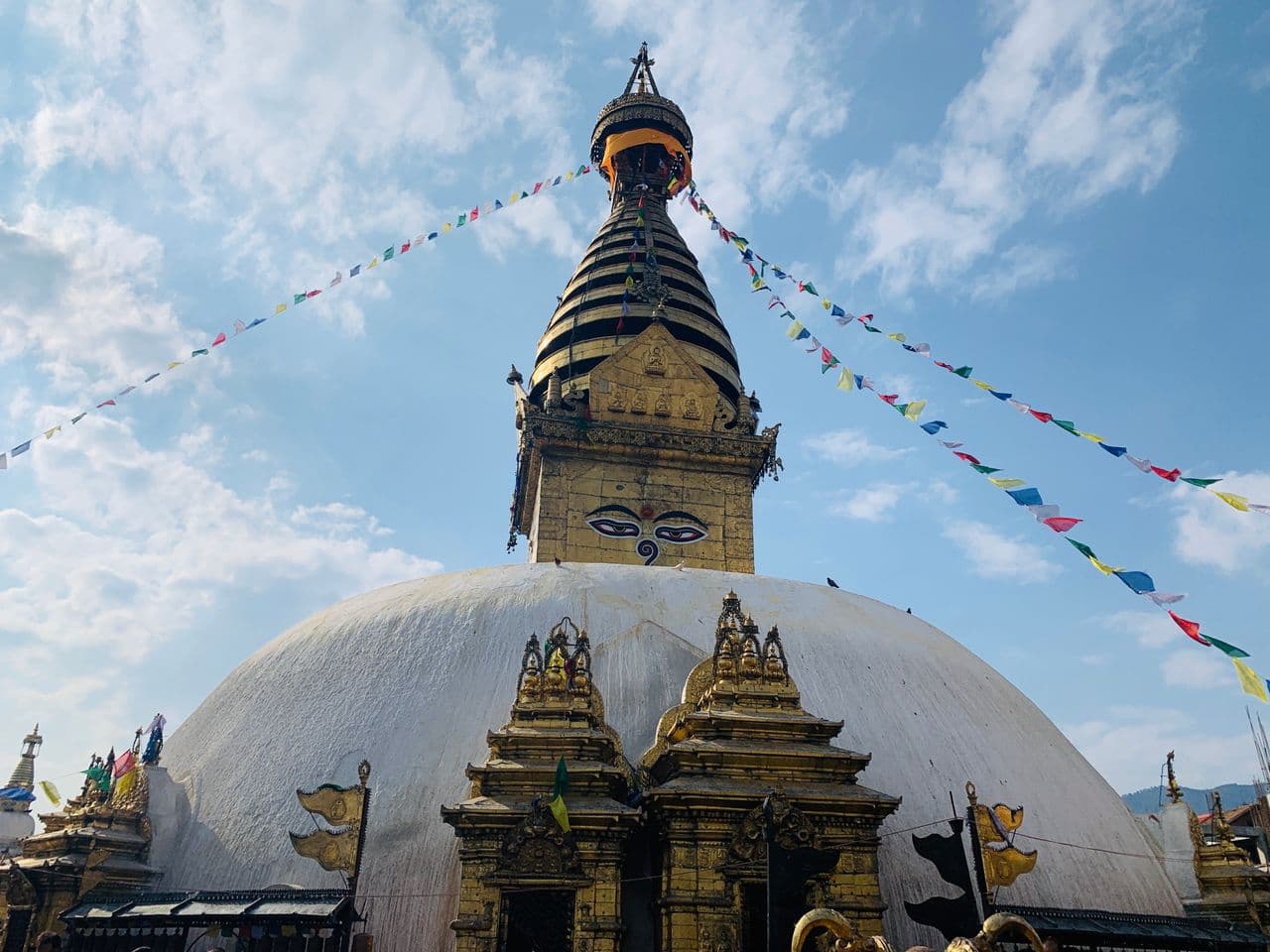
"Swayambhu / Monkey Temple"
Swayambhunath Stupa commands a hill in the western edge of Kathmandu Valley. Revered by both Buddhists and Hindus, 'Swayambhu' translates to 'Self-Existent One', rooted in ancient creation legends of the valley.
Reached via a steep stone staircase of 365 steps, the hilltop complex features the primary dome stupa, a gold pinnacle with the eyes of Buddha, surrounding chaityas, and the Harati Devi Temple.
How Swayambhunath Stupa was built and used over time, what happens there during festivals, and what to know before you arrive.
According to the Swayambhu Purana, the entire Kathmandu valley was once a vast lake. A radiant lotus sprouted in the center, which transformed into the hilltop stupa when Manjushri drained the lake with his sword.
During the holy monsoon month of Gunla, Newar Buddhist devotees wake at dawn to walk up the hill playing traditional flute and drum music.
Keep food items secure inside bags as resident rhesus macaques (monkeys) are active along the steps.
Swayambhunath Stupa (Swayambhu / Monkey Temple) lies at 1,450 m in Swayambhu Hill, Kathmandu, KATHMANDU DISTRICT, within the Kathmandu Valley region. Its setting is described as Western Valley Ridge, and the monument is associated with 5th Century AD (King Manadeva).
Most travellers reach Swayambhunath Stupa from the nearest town in KATHMANDU DISTRICT by road, then explore on foot. The recommended window is Year-Round (All 12 Months); early morning is quieter and cooler, while late afternoon offers softer light for the carved facades.
The monument represents Ancient Newar & Vajrayana Stupa, within the Self-Existent Sacred Hill tradition. Brick, timber, stone, and metal are worked together in a way that has survived earthquakes and centuries of use, and restoration at Swayambhunath Stupa continues to rely on local craftspeople.
Swayambhunath Stupa is still a working religious and community space rather than a ruin. Offerings, repairs, festivals, and everyday traffic all take place among its historic structures, so visitors should expect the site to be busy with local life as well as tourism.