Seat of Power Across Dynasties
Developed primarily during the Malla period (12th to 18th centuries) and expanded after Prithvi Narayan Shah united Nepal in 1768, Hanuman Dhoka reflects centuries of political, religious, and social history.
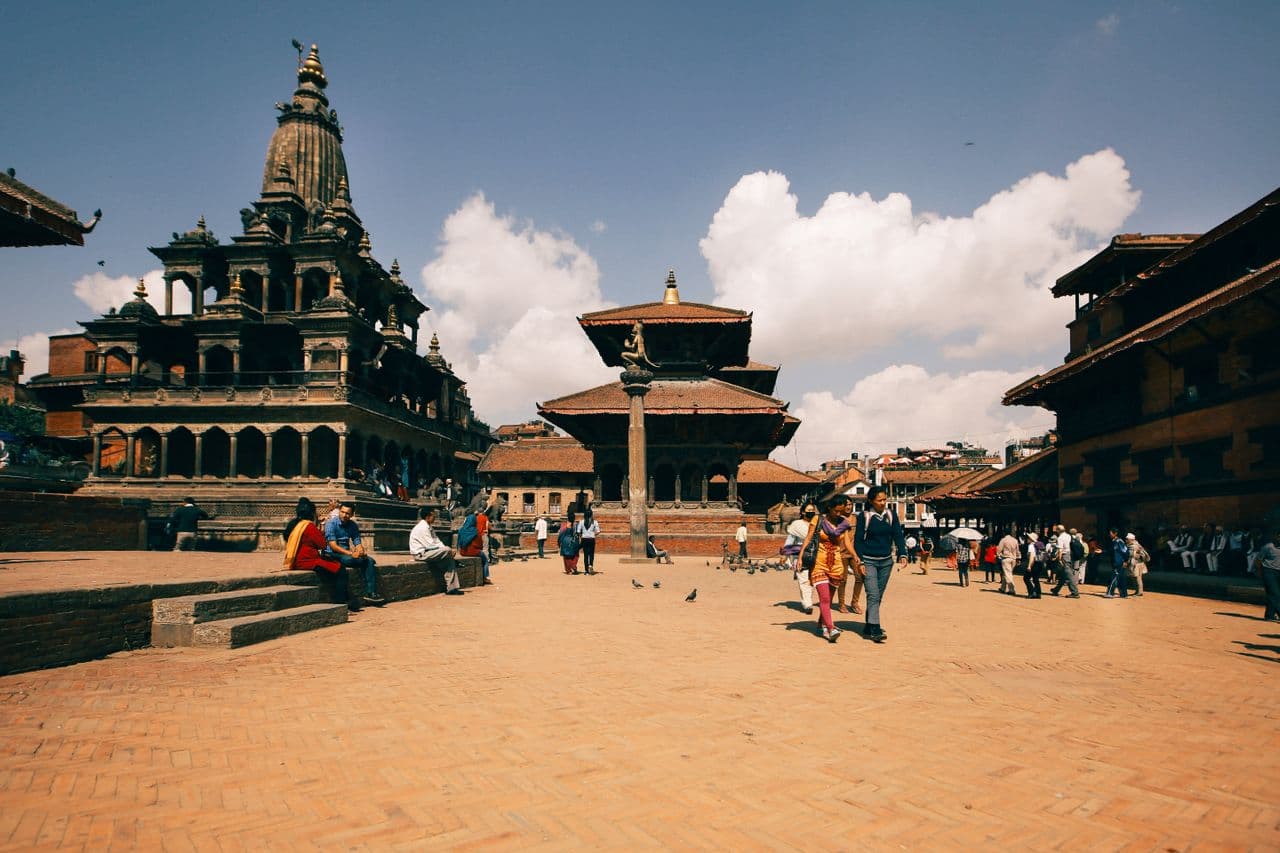
"Hanuman Dhoka Durbar"
Kathmandu Durbar Square (Hanuman Dhoka) is the ancient royal heart of Kathmandu. Surrounded by magnificent courtyard palaces, multi-tiered temples, and ancient shrines, it was the ceremonial center for coronation rituals of both Malla and Shah kings.
The plaza is world-renowned for housing the Kumari Ghar—the palace of the Living Goddess Kumari—as well as the imposing Hanuman Dhoka Royal Palace guarded by a statue of Lord Hanuman.
How Kathmandu Durbar Square was built and used over time, what happens there during festivals, and what to know before you arrive.
Developed primarily during the Malla period (12th to 18th centuries) and expanded after Prithvi Narayan Shah united Nepal in 1768, Hanuman Dhoka reflects centuries of political, religious, and social history.
Held in September, Indra Jatra features masked dances, chariot processions of the Living Goddess Kumari, and public display of the ancient wooden image of Hathu Dyo.
Photography is allowed inside the courtyard of Kumari Ghar, but strictly prohibited when the Living Goddess appears at the window.
Kathmandu Durbar Square (Hanuman Dhoka Durbar) lies at 1,400 m in Basantapur, Kathmandu, KATHMANDU DISTRICT, within the Kathmandu Valley region. Its setting is described as UNESCO World Heritage Site, and the monument is associated with 10th Century AD (Lichhavi & Malla Origins).
Most travellers reach Kathmandu Durbar Square from the nearest town in KATHMANDU DISTRICT by road, then explore on foot. The recommended window is Year-Round (Oct–April); early morning is quieter and cooler, while late afternoon offers softer light for the carved facades.
The monument represents Royal Malla & Shah Pagoda Architecture, within the Kathmandu Royal Palace Center tradition. Brick, timber, stone, and metal are worked together in a way that has survived earthquakes and centuries of use, and restoration at Kathmandu Durbar Square continues to rely on local craftspeople.
Kathmandu Durbar Square is still a working religious and community space rather than a ruin. Offerings, repairs, festivals, and everyday traffic all take place among its historic structures, so visitors should expect the site to be busy with local life as well as tourism.