Legend of the Dewdrop Stupa
Newar folklore refers to the stupa as 'Khasti', meaning dew drops, as workers gathered morning dew on cloths to mix the mortar during a severe ancient drought.
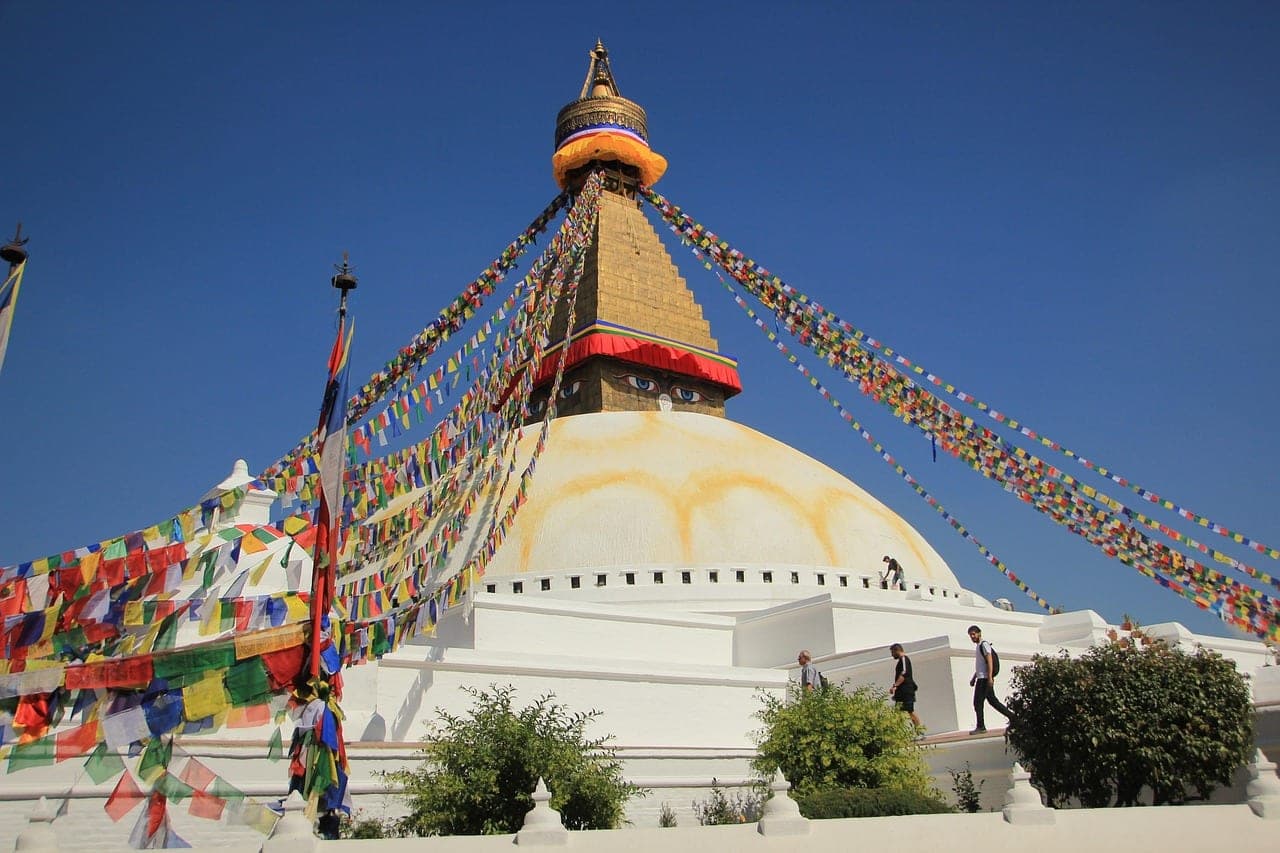
"Khasti Chaitya"
Dominating the sky with its giant eyes of Wisdom, Boudhanath is one of the largest stupas in Asia and a focal center for global Tibetan Buddhism. Its massive mandala foundation makes it an architectural marvel visible across the eastern Kathmandu valley.
Encircling the white dome is a bustling circular street lined with prayer wheels, rooftop cafes, traditional thangka art schools, and over 50 surrounding monasteries (Gompas).
How Boudhanath Stupa was built and used over time, what happens there during festivals, and what to know before you arrive.
Newar folklore refers to the stupa as 'Khasti', meaning dew drops, as workers gathered morning dew on cloths to mix the mortar during a severe ancient drought.
During Tibetan New Year (Losar) and Buddha's Birthday, the entire white dome is washed with saffron water and surrounded by thousands of butter lamps.
Always walk in a clockwise direction around the stupa dome and prayer wheels.
Dispose of waste responsibly in designated bins to keep the sacred plaza clean.
Boudhanath Stupa (Khasti Chaitya) lies at 1,380 m in Boudha, Kathmandu, KATHMANDU DISTRICT, within the Kathmandu Valley region. Its setting is described as Ancient Trade Route to Tibet, and the monument is associated with 6th Century AD (King Sivadeva).
Most travellers reach Boudhanath Stupa from the nearest town in KATHMANDU DISTRICT by road, then explore on foot. The recommended window is Year-Round (All 12 Months); early morning is quieter and cooler, while late afternoon offers softer light for the carved facades.
The monument represents Himalayan Stupa Architecture, within the Tibetan & Newar Vajrayana tradition. Brick, timber, stone, and metal are worked together in a way that has survived earthquakes and centuries of use, and restoration at Boudhanath Stupa continues to rely on local craftspeople.
Boudhanath Stupa is still a working religious and community space rather than a ruin. Offerings, repairs, festivals, and everyday traffic all take place among its historic structures, so visitors should expect the site to be busy with local life as well as tourism.